CCP’s Concept Integration in Comparative Law project has launched a new concept repository that allows researchers to explore networks of concepts across the field of comparative law.
Sartori.network Concept Repository
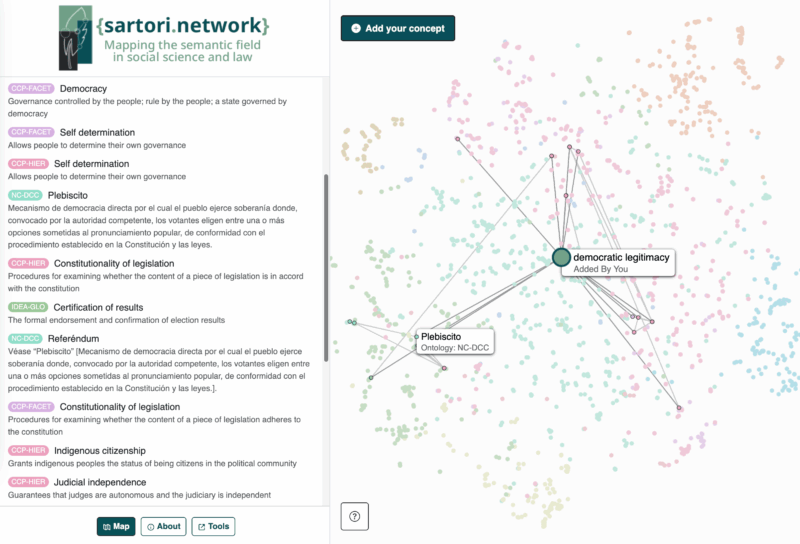
The new Sartori.network platform allows researchers to upload, map, and compare concepts from research groups spanning law, democracy, and constitutions. This provides a platform for researchers to ask, for example: What is the conceptual landscape of law and political science? What is the conceptual overlap of research projects in these domains? How does their new concept relate to established conceptual frameworks? How have other researchers conceptualized the topic under study?
The name honors eminent scholar Giovanni Sartori who urged political scientists to take their vocabulary more seriously in order to build on one another’s ideas. His key insight was that we identify and compare concepts that are in the same semantic field—a map of related concepts. To facilitate such mapping, one needs a repository of concepts from the various datasets, glossaries, and indexes in the social sciences.
The Sartori.network concept repository brings this vision to life, providing an interactive platform to explore and connect concepts across the social sciences. It currently includes 10 ontologies and 2,010 concepts from various research teams, including the Comparative Agendas Project, Comparative Constitutions Project, Constitutional Power-Sharing Dataset, Federal Judicial Center, Global Citizenship Observatory, Inclusion Dispersion and Constraint Dataset, International IDEA, and Núcleo Constitucional UAH.
The platform was developed by the Concept Integration research team, with design and implementation of this platform led by Andrés Cruz. The platform is now publicly available for other researchers to explore concepts and submit their own ontologies of concepts.
Submit your ontology today and register for the training on February 12 to learn how to use the repository and related tools in your work!
Concept Analysis Tools Training
The Sartori.network platform is part of a suite of open-source tools the team is developing for public use. The aim is to make these machine-assisted research methods accessible for a wide range of scholars and research applications across constitutional and comparative law.
The research team will host a concept analysis tools training online on all of these tools on February 12. The training will demo the tools, demonstrate varied use cases, and convey their relevance to scholars and practitioners engaged in research on a range of legal and constitutional issues. The training will also allow participants to discuss best practices related to ontologies, build working relationships, and provide a foundation for ongoing collaboration on concept integration.
Register for the training on February 12 to learn how to use the tools and concept repository in your work!
Concept Analysis Tools
The team’s suite of open-source concept analysis tools includes a constitution comparison tool (to assess the textual and thematic similarity of constitutions), a domain comparison tool (to expand the scope of topics tracked in a corpus), and a segments-as-topics tool (to formulate new topics and track them in a corpus), detailed below.
The research team developed and tested these tools as part of its own research to analyze constitutional content and expand the topics it tracks in constitutions. The team has now made the tools publicly available as open-source tools for others to start using as well.
Constitution Comparison Tool: The constitution comparison tool helps researchers systematically assess the similarity of constitutions in two ways. First, it assesses whether constitutions show textual alignment—meaning, drafters use the same language across the constitutions. Second, it assesses whether constitutions show thematic alignment—meaning, the constitutions include similar topics regardless of wording.
This allows researchers to assess, for example: How much does a draft constitution change throughout the drafting process? How much of a new constitution is copied from the one it replaced? Does a constitution borrow language from other constitutions in the region? Do constitutions from a certain region or certain time period prioritize the same issues? Which constitutions are outliers in a set of constitutions?
The constitution comparison tool is available in a public GitHub repository that includes instructions, applications, and sample data to facilitate others’ use of the tool. A video tutorial by Guillermo Pérez also walks users through how to use the tool in their own analysis.
Domain Comparison Tool: The domain comparison tool helps researchers expand and improve the topics they track in texts. It does so by drawing topics from multiple ontologies—potentially representing multiple domains—and identifying these topics in the corpus under study.
This allows researchers to assess, for example: What is the conceptual overlap between two ontologies? Which parts of a corpus include topics that are not captured by its current ontology? Which topics in new ontologies could capture the meaning of that text? Do topics in new ontologies capture more nuances of an existing topic? Should topics from other domains be included in an ontology to capture the full content of a corpus?
The domain comparison tool is available in a public GitHub repository that includes instructions, applications, and sample data to facilitate others’ use of the tool.
Segments-As-Topics Tool: The segments-as-topics tool allows users to assess the best formulation of a potential new topic for a specific corpus, identify that topic in the text, and produce an exhaustive set of segments from the corpus that reference that topic. As the name of the tool implies, it uses segments from the corpus itself to represent topics that researchers seek to find in that corpus, producing more accurate automated matching and requiring human intervention at just a few key points.
The segments-as-topics tool is available in a public GitHub repository that includes instructions, applications, and sample data to facilitate others’ use of the tool. A video tutorial by Matthew Martin walks users through how to use the tool in their own analysis.
—–
Funding acknowledgement: The Concept Integration in Comparative Law program is supported by National Science Foundation Award No. 2315189. Any opinions, findings, and conclusions or recommendations expressed in this material are those of the authors and do not necessarily reflect the views of the National Science Foundation (NSF). The research team deeply appreciates NSF’s Accountable Institutions and Behavior program and Human Networks and Data Science program for this support.